
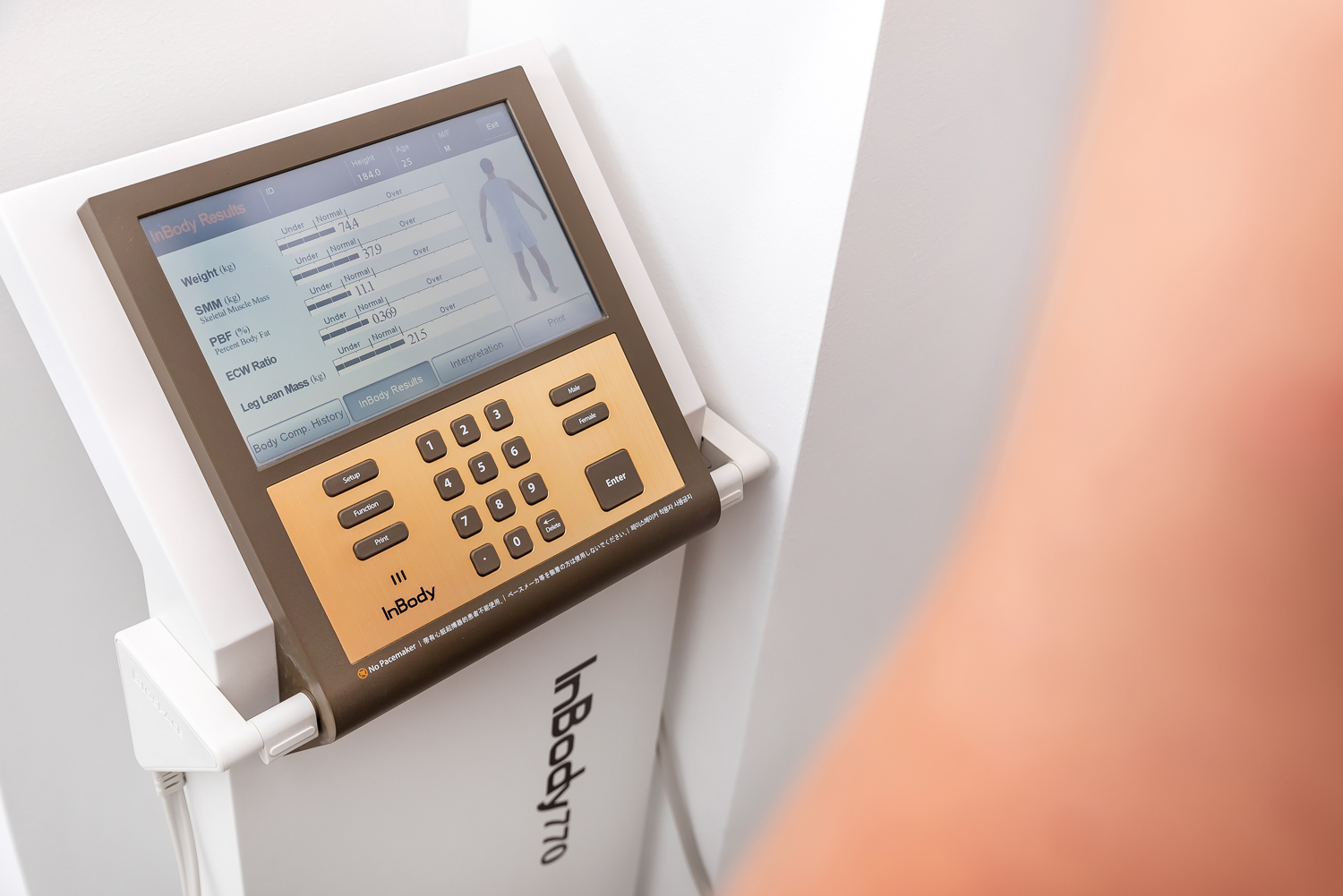
Our specialities/Body composition analysis: InBody 770
Body composition analysis with the InBody 770 in Balatonfüred
Body weight alone reveals little about the proportions of muscle, body fat and body water that make up your body. A detailed body composition analysis gives a far more accurate picture of your current condition, and can help you track changes related to lifestyle change, weight loss, sports performance or certain medical conditions.
At Tagore Medical Center, professional body composition analysis is carried out with an InBody 770 device. The test is quick and painless, and gives detailed results on the amount and distribution of body fat, skeletal muscle and body water, among other things.
- Short waiting times
- Experienced, highly regarded specialists
- Modern ultrasound diagnostics and laboratory facilities
- Thousands of satisfied patients every year
- International clinical trial background, the latest therapies
What does body composition mean?

Body composition shows the proportions of the different components that make up your body weight, primarily muscle, fat tissue and body water. Two people of the same weight and height can have very different body compositions: one may have more muscle mass, while the other may carry a higher body fat percentage at the same weight. This is why body weight or BMI alone is not always enough to assess nutritional status or the results of a lifestyle change. Body composition analysis can be especially useful when you want to track not just the change in kilograms, but also whether weight loss is genuinely reducing fat mass while preserving muscle mass as far as possible.
How does the InBody 770 body composition analysis work?
The test is simple and painless. It gives the most accurate results when performed barefoot, in loose clothing and on an empty stomach. Please do not eat, and avoid drinking larger amounts of fluid or any caffeinated or alcoholic drinks, for 2-3 hours before the test.
You stand on the foot electrodes of the device and hold the two hand sensors. Your arms should be held slightly away from your body and kept still throughout the measurement. The InBody 770 measures bioelectrical impedance at multiple frequencies, separately in both arms, both legs and the trunk. The measurement itself takes about half a minute. The results are available immediately and can be reviewed on a detailed results sheet. The results are most useful when you look not at a single figure but at body fat, muscle mass, body water and the segmental values together, and, with repeat measurements, at how they change over time.
How can body composition analysis help?

What does the InBody 770 measure?
The InBody 770 uses professional bioelectrical impedance analysis. The device passes low-intensity electrical signals through the body and determines a wide range of body composition parameters from the electrical resistance of the different tissues.
The measurement is taken in five separate body segments: the right arm, the left arm, the trunk, the right leg and the left leg.
Among other things, the InBody 770 can determine the following: body weight, total body water, intracellular and extracellular water, fat-free mass, skeletal muscle mass, body fat mass, body fat percentage, BMI, segmental muscle mass, segmental fat distribution, visceral fat values, basal metabolic rate, skeletal muscle index, InBody Score, phase angle and further research parameters.
The clinical reliability of InBody measurement has been examined in several studies against other body composition methods, such as DEXA scanning. The specific findings vary with study methodology, so we do not quote an exact percentage agreement here; the measurement is based on bioelectrical impedance analysis, an internationally established and validated method.
Who is body composition analysis recommended for?
Body composition analysis is not only useful for dieting. It may be recommended, among others: for people planning to lose weight; before starting a lifestyle change; to track the results of a diet or medical weight-loss treatment; for people who exercise regularly; before starting or changing a training programme; to monitor programmes aimed at building muscle mass; for people with sedentary jobs; as part of a health-conscious check-up; to complement dietetic advice; as part of a comprehensive assessment in diabetes, overweight or obesity; to monitor changes in muscle mass in older age; and, with repeat measurements, to track lifestyle or treatment-related changes more objectively.
The device can take measurements from the age of 3, but for children the indication for the test and the interpretation of results must be adapted to their age.
Why does abdominal (visceral) fat matter?
Where body fat is located can be at least as important as its total amount. Larger amounts of so-called visceral fat, which accumulates in the abdominal cavity around the internal organs, may be associated with an unfavourable metabolic and cardiovascular risk. The InBody 770 results therefore help assess not only total body fat mass and body fat percentage, but also provide information on abdominal fat accumulation. Visceral fat data are best interpreted together with body weight, body fat percentage, muscle mass and, where necessary, laboratory results and specialist findings.
Why is segmental muscle analysis useful?
The InBody 770 does not only determine total muscle mass: it separately analyses the fat-free mass of the right and left arms, the right and left legs, and the trunk. This can help assess whether muscle mass is evenly distributed across the body and whether there is a significant difference between the two sides. Repeat tests show how muscle quantity and distribution change during a training programme, weight loss or lifestyle change.
When is InBody analysis not recommended?
The device uses a low-intensity electrical current during the measurement. InBody analysis is not recommended for patients with a pacemaker, an implanted defibrillator or any other active electronic medical implant.
During pregnancy, the body’s fluid balance and composition change continuously, so the results are not suitable for standard body composition assessment, and the test must be discussed in advance.
Prior consultation is also required for patients with a prosthetic limb or an implant that could affect proper contact with the electrodes or the measurement result.
What is repeat body composition analysis used for?
One of the main advantages of InBody is not necessarily a single result, but the ability to track changes. During weight loss, for example, a fall in body weight alone does not show whether the body has lost mainly fat, muscle or fluid.
Repeat body composition analysis makes it possible to track, among other things, changes in body fat mass, body fat percentage and skeletal muscle mass, muscle mass on the right and left sides, abdominal fat accumulation, and body water and its distribution. This can provide useful feedback on the effectiveness of a dietetic, lifestyle, training or weight management programme.
Examinations and prices
These examinations can be booked right now, and prices are updated from our booking system. All examinations in this speciality open with one click below the list.
Examinations and prices
Orientation session with body composition analysis
Prices are in Hungarian forints (HUF) and include VAT. The laboratory package prices shown include the applicable sample handling or sample collection fee.
Try a different search term, or call our team on +36 20 280 3939 for assistance.
All examinations in this speciality5 items
Basic examinations
-
Professional body composition analysis: InBody 770 test
HUF 8,000
As a stand-alone test, with detailed measurement data and results on paper.
- Professional body composition analysis with an orientation consultation led by a dietitian HUF 16,900
-
Weight management screening package
HUF 59,990
Specialist weight management consultation
Lifestyle diagnostics (lifestyle questionnaire, BMI assessment)
Professional body composition analysis (InBody)
Detailed laboratory tests with diabetes screening (Na, K, Ca, Mg, Fe, urea, creatinine, eGFR, uric acid, blood glucose, HbA1c, insulin, CRP, total protein, albumin, total cholesterol, triglycerides, HDL, GOT, GPT, ALP, GGT, LDH, total bilirubin, direct bilirubin, full blood count, TSH, urinalysis with sediment and protein, microalbumin)
Medication and lifestyle treatment
Healthcare administration fee
-
Comprehensive weight management screening package
HUF 79,990
Specialist weight management consultation
Dietary advice package
Lifestyle diagnostics (lifestyle questionnaire, BMI assessment)
Professional body composition analysis (InBody)
Detailed laboratory tests with diabetes screening (Na, K, Ca, Mg, Fe, urea, creatinine, eGFR, uric acid, blood glucose, HbA1c, insulin, CRP, total protein, albumin, total cholesterol, triglycerides, HDL, GOT, GPT, ALP, GGT, LDH, total bilirubin, direct bilirubin, full blood count, TSH, urinalysis with sediment and protein, microalbumin)
Medication and lifestyle treatment
Healthcare administration fee
-
Diabetes complications screening package
HUF 62,400
- Diabetes specialist consultation,
- Cardiovascular risk assessment (risk score estimate)
- Resting ECG
- Peripheral arterial disease test of the lower limbs (BOSO ABI)
- Professional body composition analysis (InBody)
- Laboratory tests (Tagore routine panel, urine microalbumin)
- Healthcare administration fee
Current fees for all examinations can be found on our price list page at any time.
How should I prepare for the measurement?
Hydration, meals, physical activity and other factors can affect the results of bioimpedance measurement. For comparable results, it is therefore important to keep the test conditions as similar as possible.
For more accurate results, please try not to come straight after a meal; do not eat or drink larger amounts in the 2-3 hours before the test; avoid alcohol immediately beforehand; ideally the measurement should not take place straight after intensive exercise; it is a good idea to use the toilet before the test; the measurement is taken barefoot; please wear light clothing if possible; and follow-up measurements are best taken at a similar time of day and under similar conditions.
Frequently asked questions about body composition analysis
What is the difference between weighing and body composition analysis?
A conventional scale shows only total body weight. Body composition analysis, by contrast, helps show how much of that weight is muscle, body fat and body water. This is why someone’s weight may barely change while their body fat mass decreases and their muscle mass increases.
What is the difference between BMI and body composition?
BMI is a value calculated from body weight and height. It is a simple and widely used indicator, but it does not distinguish between muscle and fat mass. Body composition analysis provides more detailed information, as it assesses muscle mass and body fat separately, among other things.
How long does the InBody 770 measurement take?
The measurement itself takes about 30 seconds. Including preparation and handing over the results, the whole test takes a few minutes.
Is the test painful?
No. The test is non-invasive and involves no needles or radiation. The device uses very low-intensity electrical signals during the measurement.
Do I need to arrive fasting?
For the best comparability, it is advisable not to have the measurement straight after a meal. Please avoid eating and drinking larger amounts of fluid in the 2-3 hours before the test.
Can the measurement be taken after exercise?
Straight after intensive exercise is not ideal, because physical activity temporarily changes the body’s fluid distribution, which can affect the result. For follow-up measurements it is especially important that they are taken under similar conditions wherever possible.
How often should the measurement be repeated?
This depends on the purpose of the measurement. When following a lifestyle change, diet or training programme, it is generally the longer-term trends, not changes over a few days, that are worth assessing. The timing of follow-up measurements is best agreed with your dietitian, trainer or doctor to suit your programme.
Can I book the InBody 770 test on its own?
Yes. Professional body composition analysis is available as a stand-alone test with a detailed results sheet. It can also be combined with an orientation consultation led by a dietitian, and InBody 770 body composition analysis is included in several Tagore weight management and screening packages.
How much does body composition analysis cost?
Current fees can be found in the body composition analysis price list. The InBody 770 measurement is available as a stand-alone test, with a dietetic consultation, or as part of certain comprehensive screening and weight management programmes.
Where is the clinic?
- Address
- Tagore Medical Center
Balatonfüred, Horváth-ház, Gyógy tér 3. - Book an appointment
- +36 (20) 280 3939


Body composition analysis with the InBody 770 at Tagore Medical Center
If you would like a clearer picture of your body’s muscle, fat and water composition, want to track the results of weight loss or a lifestyle change, or would like to measure changes objectively alongside your sport, we look forward to welcoming you at our clinic in Balatonfüred. InBody 770 body composition analysis is available as a stand-alone test, with a dietetic consultation, and as part of comprehensive weight management and certain screening programmes. Where necessary, we also involve doctors from our other specialties.
Book an appointment online, or contact our team on +36 20 280 3939 for assistance.
Book an appointment!
Early detection can save lives, and we will help you find the right solution.
Tagore Medical Center, Balatonfüred, Horváth-ház, Gyógy tér 3.
This information is general in nature and does not replace a personal medical examination, diagnosis or treatment. If you have symptoms, please consult a specialist.